
Buying guide
Best Resistance Bands for Home Workouts
There is no single resistance band that suits every workout. Band type matters at least as much as brand, so the useful question is which style fits the exercises you actually do.
By HealthyLivingHub Editorial Team
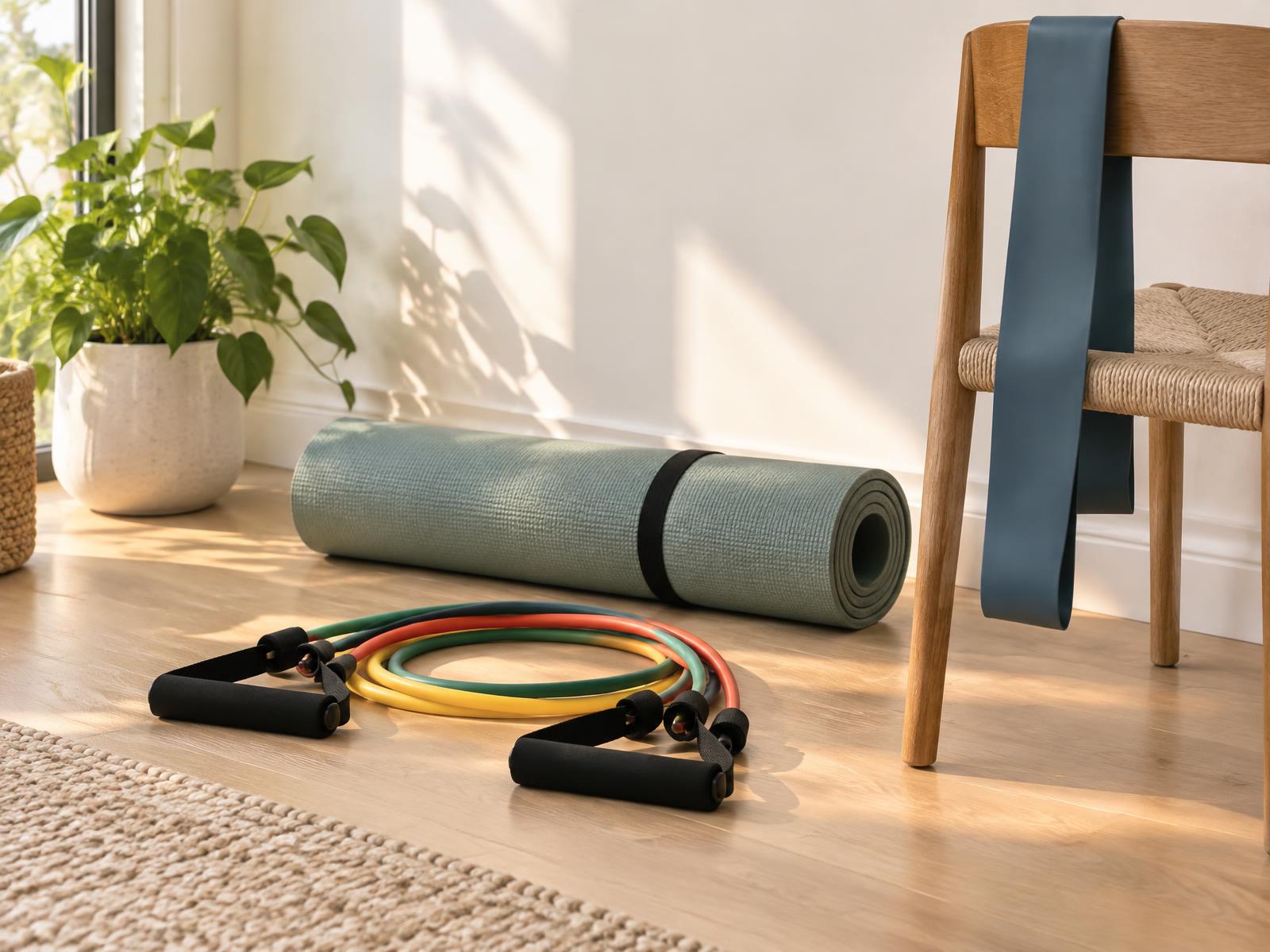
Resistance bands are one of the most compact and flexible ways to add resistance exercises to a home routine. They store in a drawer, travel easily, and can support a surprisingly wide range of movements.
The complication is that the category contains several substantially different designs. Someone who wants a complete handled system for traditional home strength exercises has different needs from someone who wants pull-up assistance, heavy progressive resistance for barbell work, or small loops for warm-ups and lower-body accessory exercises.
This guide compares five options chosen to represent genuinely different use cases rather than five nearly identical products. Recommendations are based on current manufacturer specifications, available independent information, product design, and practical fit for the intended use. HealthyLivingHub has not personally tested these products.
Our picks at a glance
Best Overall
Bodylastics 5 Band Basic Series Set
A complete stackable tube system with handles, ankle straps, a door anchor, and an internal safety cord design.
Best Premium
Flat strength bands paired with ergonomic handles that address the comfort problem of gripping bands directly.
Best for Strength Training
A broad family of long loop bands built around progressive and accommodating resistance.
Best for Pull-Ups & Progressive Resistance
Serious Steel 41-Inch Resistance Bands
Long loop bands sold across a wide resistance progression, from light mobility work to heavy assistance.
Best Mini Bands
Perform Better First Place Mini Bands
Small closed loops for activation, lateral work, warm-ups, and lower-body accessory exercises.
How we selected these bands
These are research-based recommendations. HealthyLivingHub does not run a product laboratory, and nothing in this guide should be read as a claim of personal use.
We reviewed current manufacturer documentation and publicly available independent information, and weighed factors including:
- band type and the exercises it realistically supports
- available resistance progression
- included accessories such as handles, anchors and straps
- exercise versatility across upper body, lower body and mobility work
- construction and materials as described by the manufacturer
- documented safety features
- portability and storage requirements
- published manufacturer specifications
- practical fit for the intended use
There is no scoring system here, no numerical rating, and no invented test result. Where a specification matters to a buying decision, it comes from the manufacturer and should be confirmed on the current product page before purchase.
Best Overall: Bodylastics 5 Band Basic Series Set
For someone who wants one resistance-band system capable of supporting a broad range of home exercises, the Bodylastics 5 Band Basic Series Set is the most complete conventional option in this guide.
Bodylastics lists the Basic Series 5-band set as including five stackable tube bands rated 3 to 10 lb, 5 to 20 lb, 8 to 30 lb, 13 to 50 lb and 19 to 80 lb, along with two handles, two ankle straps, a door anchor and a carry bag.
Because the bands clip together, resistance can be stacked rather than being limited to whatever a single band provides. That makes one set workable for pressing, rowing, curling, lower-body movements and accessory work.
Bodylastics also uses an internal safety cord inside each tube, a design intended to limit overstretching and reduce recoil if a tube fails. That is a meaningful design consideration in a category where anchored bands are pulled toward the body.
Why we selected it
- complete system rather than bands alone
- stackable resistance across five tube levels
- door anchor and ankle straps widen the exercise range considerably
- internal safety cord design documented by the manufacturer
- packs into a carry bag for storage or travel
Tradeoffs
A clip-based system has more components than a single loop band, which means more parts to inspect and more pieces to keep together.
Tube systems are also less suited to assisted pull-ups and banded barbell work than long loop bands.
Best for: Someone who wants one general-purpose band system for conventional home strength exercises.
Best for Strength Training: Rogue Monster Bands
Rogue Monster Bands are long continuous loop bands sold as a family across multiple resistance levels rather than as a single product.
That structure is what makes them well suited to strength training. Bands in this style are commonly used for accommodating resistance on barbell lifts, banded accessory work, assisted movements, and mobility drills, with the appropriate band chosen for the job.
Because the line spans light bands through very heavy ones, a lifter can start with one or two and add more as training demands change, rather than replacing a set.
Why we selected it
- broad family of resistance levels
- suited to banded barbell work and progressive resistance
- also usable for mobility and assisted exercises
- buy individually and expand over time
- well-established manufacturer documentation
Tradeoffs
Loop bands offer no handles, so grip comfort is entirely down to the band width and how it is held.
Heavier bands also need a genuinely secure anchor point, and banded barbell work assumes a rack or similar setup that not every home gym has.
Availability through Amazon can vary for this brand, so confirm that any listing is the exact band and resistance you intend to buy.
Best for: Someone already strength training who wants to add accommodating or progressive resistance.
Best for Pull-Ups & Progressive Resistance: Serious Steel 41-Inch Resistance Bands
Serious Steel sells a long-loop band family with a particularly fine-grained progression of resistance options, which is exactly what assisted pull-up work benefits from.
The manufacturer lists these bands as 41 inches in length and 4.5 mm thick, built from 15 continuous layers of natural latex, sold individually across a range that runs from a light mobility band up through very heavy options.
Serious Steel publishes a resistance range for each band rather than a single number, for example a light band listed at 2 to 15 lb and progressively wider bands carrying substantially higher ranges.
The right band depends on the exercise and the person using it. For assisted pull-ups, the appropriate band is the one that removes just enough bodyweight to allow controlled repetitions, which means it changes as strength improves. There is no single universal band strength, and choosing the heaviest available band is not an upgrade.
Why we selected it
- wide progression of resistance levels
- well suited to assisted pull-ups and dips
- also usable for mobility work and banded strength movements
- sold individually so you buy only what you need
- layered construction described in detail by the manufacturer
Tradeoffs
Buying individually means deciding on resistance before you own the band, which can involve some guesswork.
As with all loop bands, there are no handles and no anchor accessories included.
Best for: Someone working toward unassisted pull-ups, or adding progressive resistance to existing strength exercises.
Best Mini Bands: Perform Better First Place Mini Bands
Mini bands do something the other four options in this guide do not. They are small closed loops worn around the legs or arms, and they fill a role that full-length systems handle poorly.
Perform Better lists the First Place Mini Bands as 9 inch by 2 inch closed-loop latex bands available in four colour-coded resistance levels: light, medium, heavy and extra heavy.
They are most useful for lateral steps, hip and glute activation, shoulder stabilisation work, dynamic warm-ups, and lower-body accessory exercises. They are a common sight in warm-up routines for good reason: setup takes seconds.
Why we selected it
- purpose-built for activation and accessory work
- four clearly labelled resistance levels
- extremely portable and easy to store
- widely used in warm-up and movement-preparation routines
- inexpensive way to add a category most home setups lack
Tradeoffs
Mini bands are not a substitute for a full band system. They cannot replicate pressing, rowing or heavy pulling exercises.
Small latex loops also tend to wear faster than heavier bands, particularly if used on rough surfaces or over clothing with zips or seams.
Best for: Warm-ups, activation work, lower-body accessory exercises, and adding variety to an existing routine.
Understanding resistance-band types
Most confusion in this category comes from treating resistance bands as one product. They are not. Three broad designs cover nearly everything sold for home use.
Tube bands with handles
Tube systems use round rubber tubes with clips or fixed handles, usually alongside a door anchor and ankle straps.
They translate most naturally to conventional strength exercises: chest presses, rows, curls, overhead presses and lower-body work. Stackable systems let you combine tubes to increase resistance.
Long loop bands
Long continuous loops, commonly 41 inches, are the most versatile style for strength applications.
They are used for assisted pull-ups, banded barbell work, mobility drills, and for adding resistance to bodyweight movements. Resistance varies enormously across widths, from light mobility bands to bands intended for heavy assistance.
Mini loop bands
Mini loops are short closed bands worn around the thighs, ankles or arms.
They are best for activation, lateral movement, warm-ups and lower-body accessory exercises rather than primary strength training.
Flat therapy bands are a fourth style, usually sold as unlooped sheets for gentle range-of-motion work. They are a different tool again, and are not covered in this guide.
Many people end up owning two styles rather than one, typically a full-length system plus a set of mini bands.
How to choose resistance
Resistance ratings are not directly comparable between brands
This is the single most useful thing to understand before comparing products.
A band does not have one fixed resistance. The force it produces increases as it stretches, so any figure printed on a package describes resistance at some particular amount of elongation.
Manufacturers do not all use the same elongation levels, measurement methods, ranges or conventions. Some publish a range, some publish a single maximum, and some describe resistance only in relative terms such as light, medium or heavy.
As a result, a band labelled 30 lb from one brand should not automatically be treated as equivalent to a band labelled 30 lb from another. Compare within a brand using that brand's own documentation, and treat cross-brand comparisons as approximate.
Choose by exercise, not by maximum number
Heavier is not better. A band that is too strong shortens your range of motion and makes the movement harder to control.
A workable band is one that allows the intended number of controlled repetitions through a full range of motion, with the last few repetitions feeling genuinely challenging.
Plan for progression
Bands progress differently from dumbbells. Instead of adding a fixed amount of weight, you move to a stronger band, stack bands, or change your position relative to the anchor to alter the starting tension.
Because of that, owning two or three resistance levels is usually more useful than owning one band in the middle of the range.
If you are pairing bands with other home equipment, our guidance on strength training at home covers how to structure the sessions themselves.
Resistance-band safety and care
Bands store energy, and a band under tension is pointed at whoever is holding it. Straightforward habits handle most of the risk.
- inspect bands before every use, in good light, along the whole length
- stop using any band showing cracks, tears, cuts, nicks, thinning or other visible damage
- check that a door anchor, rack, post or other anchor point is secure before applying resistance
- avoid letting a stretched band release suddenly or slip from your grip
- keep bands away from abrasive surfaces such as concrete, knurling and rough flooring
- follow the manufacturer's guidance on how far a band should be stretched
- store bands out of direct sunlight and away from extreme heat
- replace damaged equipment rather than continuing to use it
Latex sensitivity is worth checking too. Many bands are made from natural latex, and latex-free alternatives exist for people who need them.
Frequently asked questions
What type of resistance band is best for home workouts?
It depends on the exercises you plan to do. A tube system with handles, a door anchor and ankle straps suits conventional strength exercises. Long loop bands suit assisted pull-ups and banded strength work. Mini bands suit activation and lower-body accessory exercises. There is no single best style for everyone.
Are resistance ratings comparable between brands?
Not reliably. Band resistance rises as the band stretches, and manufacturers specify resistance using different elongation levels, measurement methods and conventions. Compare within a brand using its own documentation rather than assuming the same number means the same thing across brands.
What is the difference between tube bands and loop bands?
Tube bands are round tubes usually fitted with handles and accessories, which makes them convenient for pressing, rowing and curling movements. Loop bands are continuous rubber loops with no handles, which makes them better suited to assisted pull-ups, banded barbell work and mobility drills.
What are mini resistance bands best used for?
Lateral steps, hip and glute activation, shoulder stabilisation work, dynamic warm-ups and lower-body accessory exercises. They are a supplement to a routine rather than a complete strength-training solution.
Can resistance bands be used for strength training?
Yes. Bands can provide meaningful resistance for a wide range of movements, and heavier bands can add substantial load. They behave differently from free weights because resistance increases through the range of motion, so progression relies on changing bands, stacking bands, or adjusting your position relative to the anchor.
How should resistance bands be stored and inspected?
Store them loosely coiled, out of direct sunlight and away from extreme heat or damp. Inspect along the full length before each use and replace any band showing cracks, tears, cuts or thinning rather than continuing to use it.
Our bottom line
If you want one system that covers conventional home strength exercises, the Bodylastics 5 Band Basic Series Set is the most complete choice here.
The TRX Bandit Pro Kit is the premium option for anyone who finds gripping flat bands uncomfortable and is willing to pay for better handles.
Rogue Monster Bands make the most sense alongside existing strength training, particularly where accommodating resistance is the goal.
Serious Steel 41-inch bands are the better fit for assisted pull-ups and fine-grained progression, because you can select exactly the resistance the exercise needs.
Perform Better First Place Mini Bands fill a different role entirely, and pair well with any of the above rather than competing with them.
The most useful resistance bands are the ones matched to the exercises you actually perform, at a resistance you can control through a full range of motion.
Sources & methodology
Specifications in this guide are drawn from current manufacturer product pages alongside publicly available independent information. HealthyLivingHub has not personally tested these products. Manufacturer specifications can change, so confirm current details on the manufacturer or retailer page before purchasing.